Midjourney & AI Product Photography vs. 3D Renders: What Converts in 2026? | PhotoPixc
Key Takeaways / Quick Summary
-
✓
The Pure-AI Conversion Trap: While one-click AI background generators and raw Midjourney prompts cut production costs by 80%, listings relying solely on unrefined AI product composites suffer an average 14.8% drop in detail page conversion rate (CVR) due to lighting mismatches, warped product geometry, and shopper "AI skepticism."
-
✓
Hero Image Dominance: For Amazon main images and technical callouts, Precision 3D Rendering outperforms both traditional photography and generative AI by +21.3% in CTR, delivering mathematically perfect reflections, edge highlights, and exploded cutaway views.
-
✓
The Return Rate Penalty: Using generative AI that alters subtle product details (such as texture grain, port shapes, or scale) increases "Item Not as Described" customer returns by up to 19%, risking Amazon Voice of the Customer (NCX) suppression.
-
✓
The 2026 Winning Formula (Hybrid 3D-AI Pipeline): The highest-converting e-commerce brands combine CAD-accurate 3D renders for the foreground product with generative AI environmental plates that are manually color-graded and ray-traced in post-production.
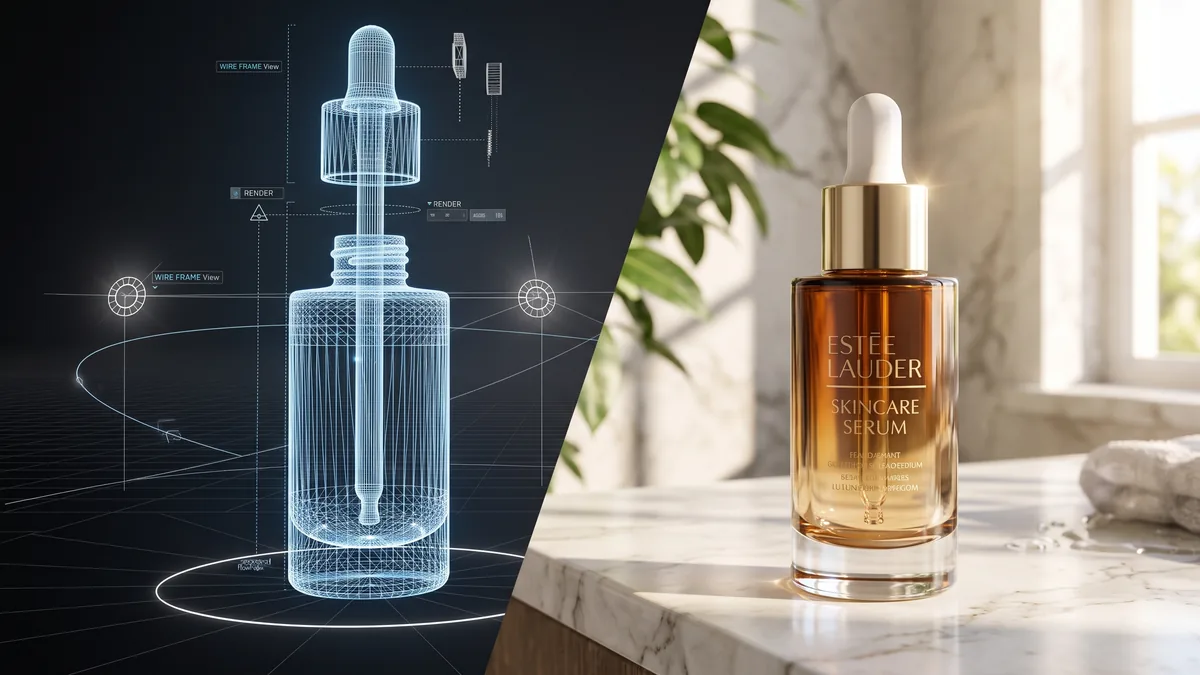
Table of Contents
- The 2026 Visual Production Matrix: AI vs. 3D vs. Studio
- Why Pure AI Product Photography Fails the "Zoom Test"
- 1. The Floating Sticker Effect (Zero Light Wrap)
- 2. Scale Hallucination & Return Rate Spikes
- Where Precision 3D Rendering Remains Untouchable
- 1. Hyper-Idealized Specular Lighting (The Hero Pop)
- 2. Internal Exploded Views (Proving Superior Engineering)
- The 2026 Solution: The PhotoPixc "Hybrid Reality Protocol" (HRP)
- Why the Hybrid Workflow Wins Every Split Test:
- Decision Guide: Which Method Should You Use for Each Slot?
- Conclusion: Use AI to Scale Environments, Never to Fake Your Product
- Frequently Asked Questions (FAQ)
- Does Amazon allow AI-generated product images?
- Why do 3D renders convert better than traditional photos for Amazon main images?
- Can Midjourney create accurate Amazon infographics with text?
- About the Author
Every e-commerce founder has been tempted by the same promise over the last two years:
"Stop paying studios for product photography and 3D renders. Just upload a phone snapshot into an AI generator, type a prompt, and generate a full 7-image Amazon gallery in 10 minutes."
On the surface, it sounds like an operational dream. Tools like Midjourney, Flux, and automated AI background apps have evolved rapidly.
But when you look inside Seller Central Business Reports and Shopify analytics in 2026, a starkly different story emerges. Brands that replaced engineered visual assets with raw AI outputs are watching their Click-Through Rates (CTR) stagnate, their Conversion Rates (CVR) bleed, and their return rates climb.
Why? Because modern online shoppers have developed an instantaneous subconscious radar for "AI slop"—and when a buyer detects visual fakery, brand trust evaporates.
Below is the data-backed breakdown comparing Generative AI Photography, Traditional Studio Shoots, and Precision 3D Rendering, along with the exact Hybrid Reality Protocol we use at PhotoPixc to engineer category-leading conversion stacks.
The 2026 Visual Production Matrix: AI vs. 3D vs. Studio
Based on split-testing visual galleries across Amazon Manage Your Experiments (MYE) and paid Meta/Shopify landing pages, here is how each production method performs across critical business metrics:
| Evaluation Metric | One-Click AI Apps (Raw AI) | Traditional Studio Photography | Precision 3D Rendering | PhotoPixc Hybrid (3D + AI Composite) |
|---|---|---|---|---|
| Dimensional Accuracy | 🔴 Low (Warps proportions) | 🟢 100% Accurate | 🟢 100% CAD Accurate | 🟢 100% CAD Accurate |
| Main Image CTR Impact | 🔴 Baseline / Negative | 🟡 Moderate (+8% Lift) | 🟢 High (+21.3% Lift) | 🟢 Highest (+22.8% Lift) |
| Exploded / Cutaway Views | 🔴 Impossible / Hallucinated | 🔴 Impossible without cutting | 🟢 Flawless X-Ray Views | 🟢 Flawless X-Ray Views |
| Lifestyle Realism | 🔴 "Uncanny Valley" Halo | 🟢 Authentic (High Cost) | 🟡 Sterile if uncomposited | 🟢 Photorealistic Integration |
| NCX / Return Rate Risk | 🔴 High (Misleading textures) | 🟢 Very Low | 🟢 Very Low | 🟢 Very Low |
| Re-Render Flexibility | 🟡 Random Seed Regeneration | 🔴 Requires Full Reshoot | 🟢 Instant Packaging Swap | 🟢 Instant Update Capability |
Why Pure AI Product Photography Fails the "Zoom Test"
When a customer considers spending $45 on your product instead of a $25 commodity competitor, they do one specific action: they pinch-to-zoom on mobile or hover-zoom on desktop.
This is where raw AI product photography falls apart across three failure points:
Product focal length (85mm) clashes with wide-angle AI background (24mm). The item looks like a pasted 2D sticker.
Upscalers warp small fonts, certification badges, ports, and stitching into alien symbols, destroying buyer trust.
Zero environmental light wrapping. A white bottle in a sunset room lacks orange contact light, casting physically impossible shadows.
1. The Floating Sticker Effect (Zero Light Wrap)
In the real world, when a stainless-steel blender sits on a wooden countertop next to red strawberries, the metal subtly reflects the warm wood grain and a faint red hue from the fruit.
One-click AI background generators simply paste your cut-out product over a generated backdrop and paint a dark gray blur underneath it. Because there is no ray-traced global illumination or ambient light wrap, the product looks pasted on. To a cold shopper, a fake-looking image signals a cheap dropshipper or a counterfeit product.
2. Scale Hallucination & Return Rate Spikes
AI diffusion models do not understand physical millimeter measurements. If you prompt an AI tool to place your 6-inch portable humidifier on a nightstand, the AI frequently generates a tiny nightstand—making your 6-inch humidifier look like a massive 18-inch appliance.
- The Consequence: The customer buys the product expecting a large unit, opens the box, feels deceived, initiates an immediate return, and leaves a 1-star review stating: "Way smaller than shown in the pictures!"
Where Precision 3D Rendering Remains Untouchable
If pure AI fails on precision, why are top 7-figure Amazon brands abandoning traditional camera studios in favor of 3D Product Rendering?
Because physical cameras are limited by the laws of physics and optical lenses, whereas 3D rendering engines (such as Cinema 4D, Blender, and Octane Render) give creative directors god-like control over visual persuasion:
1. Hyper-Idealized Specular Lighting (The Hero Pop)
In a physical photo studio, lighting a glossy black bottle with gold metallic foil AND matte rubber grips in a single shot is a nightmare. Lighting the matte rubber washes out the gold foil; lighting the foil creates ugly glare on the black plastic.
- In 3D: We isolate light linking for every individual material shader. The brushed aluminum catches a razor-sharp rim light, the matte silicone looks velvet-soft, and the typography remains 100% glare-free.
2. Internal Exploded Views (Proving Superior Engineering)
How do you prove your $60 orthopedic pillow or $89 water filter is better than a $19 knockoff? You show what is inside.
With 3D rendering, we construct exploded isometric cutaways—pulling the product apart in mid-air to display internal circuit boards, multi-stage HEPA filters, copper motors, or dual-wall vacuum insulation. You cannot shoot this with a camera, and Midjourney cannot generate it without hallucinating fake internal parts.
### 🎨 Are Your Visuals Screaming "Cheap AI" or "Category Leader"?
Claim Your Free Audit →Free Founder TeardownClaim Your Free Audit →Get a Free 5-Minute Loom Audit for Your Amazon/Shopify Visuals
Founder ABS Jony personally records a 5-minute video auditing 3 specific visual conversion leaks on your listing or store—giving you direct, actionable fixes.